
We were back in Avignon today for more extensive exploration; went through the Palais des Papes this morning. It’s the largest medieval palace in all Europe, made of the local custard coloured soft limestone, just like the Gothic crenelated walls of the city. As you know the Popes were here 1309-1377, sometimes called the Babylonian Captivity. At that time, Avignon, on this side of 5he Rhône, wasn’t in France proper; it was part of the Holy Roman Empire and the church already owned it. It became a part of France in 1790— just in time for the Terror. The guillotine stood on Place de L’Horloge where today there is a large, ornate merry-go-round. (Did you know that “Carousel” was the surname of the man who invented carousels?)
I’m kinda surprised Avignon even needed the “National Razor”, as the guillotine was called, being on the Rhône: most provincial governors who had access to a river preferred the noyade: mass drownings. (Check out Swinburne’s poem “Les Noyades”….IF you dare!)
The most famous of the Avignon pontiffs was Clement VI; he added a whole new wing to the place, and he had a Court more lavish than any monarch at the time. He remarked that his predecessors “just didn’t know how to be Pope!” He personally bought the City of Avignon proper from Joanna Queen of Naples, who was hard up for cash at the time. When we went through his large Gothic chapel, the guide invited us to sing, said the acoustics were fantastic, so of course I did, and it almost made me cry: the echoes of my voice went on for about ten seconds after I had finished the hymn.
France has been working on reconstruction of the palace ever since the depredations of the 1789 revolution, when the religious frescos were vandalized with anti-clerical fervor. then the use of the place as a prison, then a military barracks, during the French Revolutionary wars and most recently during WW II. In light of all that, I thought it was so funny that they were checking people’s bags on the way in: really, what could you be carrying in a purse or backpack that could possibly inflict any additional damage on this centuries-old structure?
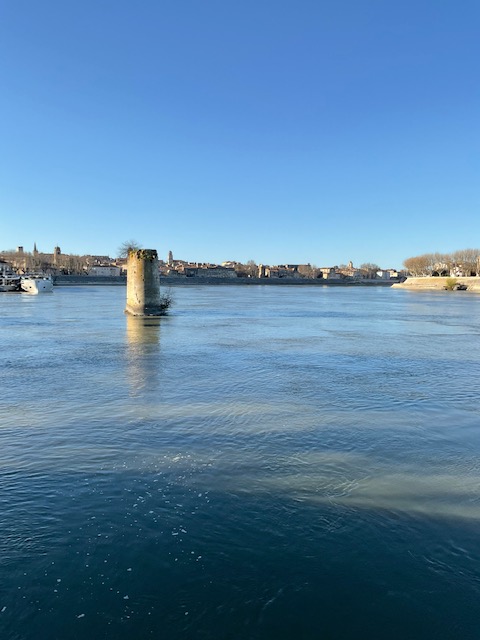
This afternoon we walked back into the city, then out on the eponymous bridge. It’s really called Pont St Benezet, after the shepherd boy who had a vision directing him to see a bridge built there back in the 12th century; everybody laughed at him. but he proved his bona fides by picking up a huuuuge boulder and chucking it into the river with superhuman strength. The Pont d’Avignon now ends ignominiously short of the mid-river island—but, great view of the city from there! It’s kinda narrow, and when it was built of course there were no railings, so during mistral season ( that’s a ferocious wind Provence gets in winter) people used to stop in at a chapel on the Avignon side to pray that they would cross without getting blown off into the icy Rhône.
And that made it a full 8 miles that we’ve walked today 😰 ! Sailing for Viviers tonight.
…we had a “Taste of Provence” dinner tonight, Bouillabaisse, duck, lamb, ratatouille…and at the end we got to taste Pastis, the traditional tipple of Provence, a licorice tasting cloudy yellow lookIn’ drink—I don’t recommend it, but the characters in the novel about Avignon that I’m reading are always drinking it, so…research!
À demain!

 ST UnWoked & UnVaxxed!
Enjoying your posts immensely; always fun to tag along in your wake! Does the air in Provence have an aroma of lavender? Or am I in the wrong season for the lovely stuff?
LikeLiked by 1 person
No, we’ve seen a lotta lavender; it’s not in bloom yet, but the countryside is aromatic!
LikeLiked by 1 person
UMMMMMM……
LikeLike